The Upward Path
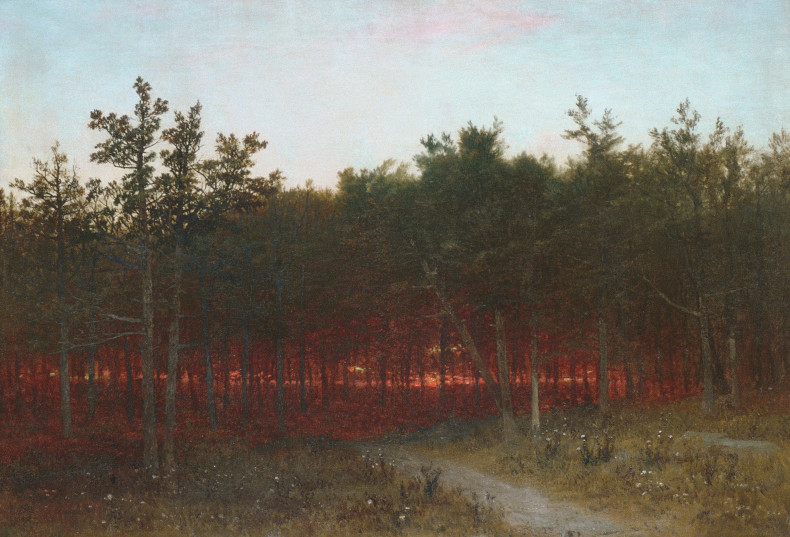
Image: Twilight in the Cedars at Darien, Connecticut, John Frederick Kensett
The Limits of the Horizon
In the modern era, we tend to view knowledge as an accumulation. We treat learning as a horizontal expansion, gathering of more data, more empirical evidence, and more pixels of information to fill a growing digital archive. But for Plato and Augustine, knowledge was never a matter of accumulation; it was a matter of ascension.
To the classical mind, the pursuit of truth was not a gathering of shadows, but a vertical movement of the soul. It was an upward lifting from the flickering, unreliable world of the senses toward a more stable, luminous reality. While separated by centuries, Plato and Augustine share a fundamental architectural vision of the human intellect: they both believe that while reason provides the ladder, the climb itself requires a fundamental turning of the soul.
To understand this, we must look past the logic of the syllogism and toward the mechanics of illumination. For both thinkers, the greatest barrier to truth is not a lack of information, but a lack of orientation. We do not fail to see the truth because it is hidden; we fail to see it because we are looking in the wrong direction.
The Geometry of Ascent (Knowledge as Upward Movement)
Plato’s Divided Line offers a geometric metaphor for knowledge, dividing reality into two realms: doxa (opinion) and episteme (true knowledge). This is not merely a distinction between “guessing” and “knowing,” but a distinction between the shifting and the stable. The lower realm of doxa is the world of shadows, reflections, and sensory perceptions. These things are in a constant state of flux, decaying and regenerating. The higher realm, however, is the domain of the eternal. This ascent is a movement from the particular to the universal; it is the movement from seeing a single, dying tree to understanding the eternal Form of “Tree-ness.”
Augustine takes this Platonic architecture and breathes into it a restless, human spirit. If Plato’s ascent is a philosophical journey of the intellect, Augustine’s ascent is a journey of the soul. In his Confessions, the climb is not merely academic; it is a struggle of the will. The “climb” is the movement from the fragmented self, scattered among worldly desires, to the unified self, found only in the presence of the Divine. Plato moves from the shadow to the Form, highlighting the capacity of reason to make the ascent. Augustine moves from the temporal to the eternal, but doubts that reason is sufficient to gain true understanding. Both, however, agree on the fundamental direction of human progress: we do not find truth by looking outward at the periphery of things, but by ascending toward their source.
The Light within the Eye (The Role of Illumination)
If the journey of knowledge is an ascent, then we must ask: what is it that makes the climb possible? If we are moving from the darkness of the cave to the brilliance of the sun, what is the mechanism that allows the eye to perceive the light? Both Plato and Augustine suggest that the truth is not merely “out there” waiting to be discovered, but that the intellect requires a specific kind of lighting to make reality intelligible.
In the Allegory of the Cave, Plato introduces the Sun as the ultimate metaphor for the Form of the Good. The Sun performs a dual role: it provides the light by which we see, and it provides the energy that allows life to exist. In Plato’s framework, the Sun represents the source of all being and truth. Without the “light” of the Good, the Forms would remain as unreachable and dark as the shadows on the cave wall. For Plato, the ascent is a process of training the eye to adjust to a higher intensity of light, moving from the flickering, deceptive shadows of the material world toward the steady, unblinking radiance of the intelligible realm.
However, while Plato’s Sun provides a cosmic metaphor for the source of truth, Augustine brings this light inward, transforming a cosmological concept into a psychological and spiritual reality.
For Augustine, the “light” is not merely an external force that illuminates objects; it is a divine presence that “lights” the human intellect itself. In his doctrine of Divine Illumination, Augustine argues that the human mind, being finite and prone to error, is incapable of grasping eternal, immutable truths through its own power alone. Just as the physical eye requires light to see color and shape, the human intellect requires a “divine light” to perceive eternal truths such as mathematics, logic, and morality.
In this view, truth is not something we “construct” through dialectic, but something we “recognize” because God provides the internal illumination necessary to see it. Here, the ascent becomes even more intimate. For Plato, the climber moves toward a distant Sun; for Augustine, the light is already bathing the mind, waiting for the soul to turn its gaze upward to notice it.
In both thinkers, we find a profound rejection of pure empiricism. They both suggest that the mere collection of sensory data is insufficient for true understanding. To know the truth, it is not enough to look at the world; one must be illuminated by a source that transcends the world. The architecture of knowledge, therefore, is not built of bricks of information, but of rays of light. It is a movement from the seen to the unseen, from the shadow to the source.
Reason and Revelation: Bridging the Gap to Understanding
There is a profound tension at the edge of the intellect. We can build a ladder of logic, rung by rung, using empirical observations to climb ever higher toward the truth. But as we approach the summit, the ladder begins to tremble. This is the limit of logos. In the Platonic tradition, the intellect can grasp the Forms, but it eventually reaches a point of awe where the clarity of thought gives way to a sublime mystery.
This is where it reason reaches its limits. As Augustine demonstrates, reason can lead us to the threshold of understanding, but it cannot carry us through the door. There is a vast space between what can be proven and what must be believed. To rely solely on the ladder of reason is to remain trapped in the realm of the measurable and the finite. To bridge the gap, one requires a different faculty: a recognition that knowledge is important, but is part of a much higher reality. This is not an abandonment of reason, but its fulfillment. The leap of faith is not a flight from the truth, but a courageous venture into the depths of a truth that is too vast for the intellect to contain. It is the moment where the seeker ceases to be an observer of the light and becomes a participant in it.
The Existential Echo
In our contemporary era, we are drowning in information but starving for wisdom. We live in a digital “Cave,” surrounded by a relentless stream of shadows. Algorithms, notifications, and curated images present a flickering, fragmented version of reality. We have perfected the art of gathering doxa; we have mastered the collection of shadows. Yet, despite our unprecedented access to the “data” of the world, we find ourselves increasingly lost in the flux.
The relevance of the ascent lies in the realization that more information does not equate to more truth. The modern crisis is not a lack of content, but a lack of direction. We have the tools to map the shadows with incredible precision, but we have forgotten how to look upward. The challenge posed by Plato and Augustine remains the same: to resist the gravity of the ephemeral and to seek the stability of the eternal. The ascent requires us to look past the screen and the sensation and continue the ascent toward enduring understanding.
Related on Quiet Frontier
On the Wiki
About the Author
Rod Price has spent his career in human services, supporting mental health and addiction recovery, and teaching courses on human behavior. A lifelong seeker of meaning through music, reflection, and quiet insight, he created Quiet Frontier as a space for thoughtful conversation in a noisy world.
Comments
Quiet Frontier welcomes thoughtful discussion and differing perspectives. The goal is not agreement, but clarity, reflection, and mutual respect.
Please keep the following in mind:
Engage ideas, not individuals. Disagreement is welcome; personal attacks are not. Contribute with intention. Comments should add perspective, ask meaningful questions, or extend the discussion. Clarity over emphasis. Excessive or gratuitous profanity may be removed—not as a matter of offense, but because it often replaces clear expression. Avoid noise. Spam, self-promotion, and low-effort comments may be removed. Assume responsibility for your words. This is a space for considered thought, not impulsive reaction.
Comments are moderated. The aim is not to control discussion, but to maintain a space where meaningful dialogue remains possible.
How to comment
- Enter your name and email address.
- A verification email will be sent to that address.
- Copy the token from the email.
- Paste the token into the token field here on the site.
- Submit your comment. or
- You can log use your GitHub login.
No account or password is required. This process simply helps keep the comment section free of spam and more focused on genuine discussion.